When someone tells me they want to strengthen their back, the first thing I ask is how they breathe. The answer is usually a puzzled look. What does breathing have to do with the back?
It has everything to do with it.
The diaphragm is not only a breathing muscle
Everyone knows the diaphragm is the main muscle of breathing. What almost no one knows is that it also stabilises the spine.
Think of it this way: before you lift something off the floor, before you carry the shopping, even before you get up from a chair, the body needs to prepare the spine for that movement. The diaphragm is part of that preparation system. When it works well, it acts as an internal support that protects the spine while you move. When it does not work well, the spine works without that support — and compensates with tension elsewhere.
The research on this is clear: dysfunction of the diaphragm as a stabiliser is directly associated with recurring lower back pain (Janssens L et al., 2015 · PMID 25539480).
How to tell whether yours is well activated
The easiest sign to spot is to watch how you breathe.
When you inhale, do your shoulders rise? Is it the upper chest that moves the most? Do you have chronic tension in the neck or upper trapezius without a cause that fully explains it?
That pattern — breathing high in the chest, with the shoulders involved, with the neck working harder than it should — is very common. And it has direct consequences for the back: when breathing does not activate the diaphragm well, the muscles of the lower back have to do extra work to make up for what the diaphragm is not doing. Over time, that takes its toll.
What 3D costal breathing is and how to practise it
It is not a new or complicated technique. It is recovering the pattern the body is designed for.
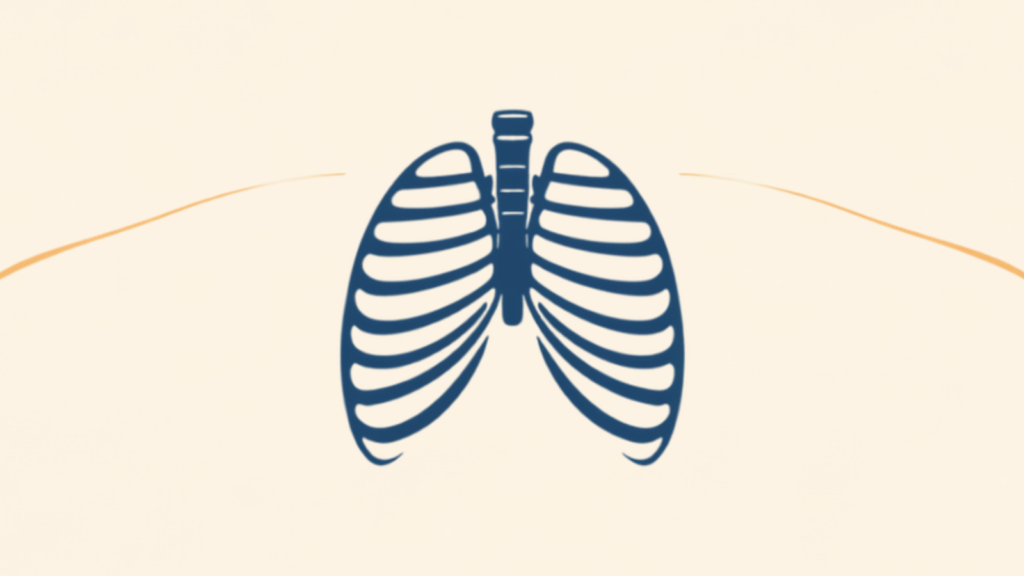
The key is to direct the breath towards the sides, not upwards or into the abdomen. Your hands help you understand it: place them on the sides of your torso, just below the armpits. As you inhale, try to make the ribs push your hands outwards. Not upwards. Outwards.
If you feel that, the diaphragm is working. If your hands do not move and your shoulders rise instead, the usual pattern is still in charge.
To practise it:
Sit or lie down comfortably. Close your mouth and inhale through your nose for three or four seconds, directing the air into that lateral expansion. Do not raise your shoulders. Exhale fully before repeating. Six to eight breaths are enough to begin with.
At first it is hard to feel — any new pattern needs practice. But with a few days of daily attention, the movement starts to appear more naturally.
Why it matters beyond breathing
A diaphragm that works well has an effect on everything that follows: stability when you bend down, when you carry something, when you exercise. Without that active support, the superficial muscles of the back take on a load they are not designed for. And that, over time, becomes tension, fatigue and recurring pain with no obvious structural cause.
It also has an effect on the nervous system. High, shallow breathing keeps the body in a heightened state of alert. Breathing that drops low and expands laterally does exactly the opposite — it signals to the nervous system that it can lower its guard. That is why costal breathing is not only a mobility exercise. It is a tool for regulation.
What changes
The spine has an internal support it did not have before. The tension in the neck begins to ease. The overall level of activation drops a notch.
It does not all happen at once. But it does happen.
In the Reset Program, 3D costal breathing opens and closes every session — not as a ritual, but because without it the rest of the work has less of a foundation. It is the one thing you are asked to practise every day from day one. Three breaths in the morning. Three at the end of the day.
The most important muscle for lumbar stability is not the rectus abdominis. It is the one you have been using twenty times a minute without knowing it can do something else as well.
If you recognise this in your own back, the Reset Program works on all four axes of the method from session 1.